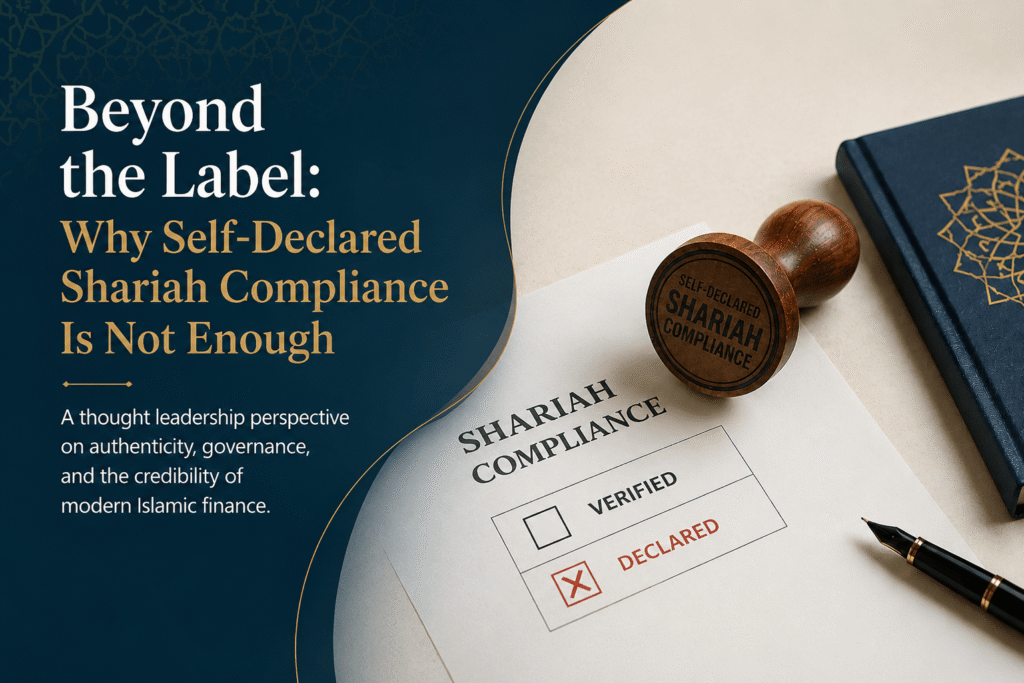
Beyond the Label: Why Self-Declared Shariah Compliance Is Not Enough
Introduction
In recent years, the global Islamic finance industry has experienced unprecedented growth. From sovereign sukuk issuances and Islamic banking windows to fintech platforms, halal investment apps, tokenised assets, and a new generation of digital financial products, the market for ethically aligned, faith-conscious finance is expanding rapidly. With this expansion, however, has come an increasingly common — and concerning — practice: the self-declaration of Shariah compliance.
A growing number of startups, fintechs, crypto projects, NFT marketplaces, investment platforms, and traditional businesses now label their products as “Shariah-compliant” based largely on the personal understanding, conviction, or interpretation of their founders or management teams. While the intention may often be sincere, the practice rests on a fundamental misconception: that an individual’s belief that something is permissible is, in itself, sufficient grounds to market it as such to the Muslim public. It is not.
Shariah compliance is not a matter of personal opinion or marketing language. It is a technical, scholarly, and institutional designation that carries with it a long tradition of methodology, jurisprudence, and verification. This article examines why self-declared Shariah compliance is inadequate, what genuine compliance actually requires, and why robust Shariah governance is essential to the long-term credibility of the Islamic finance industry.
What “Shariah Compliance” Actually Means
At its core, Shariah compliance refers to the conformity of a financial product, contract, structure, or transaction with the rules of Islamic commercial jurisprudence — known classically as Fiqh al-Muamalat. This body of law has evolved over more than fourteen centuries through the careful work of jurists across multiple schools of thought, and it addresses, among other things, the prohibited elements such as riba (interest), gharar (excessive uncertainty), maysir (speculation and gambling), and dealings in impermissible underlying activities.
Determining whether a modern financial instrument complies with these principles is rarely straightforward. Contemporary products often combine elements of contracts that did not exist in classical fiqh — securitisation, derivatives, smart contracts, fractionalised tokens, automated market makers — and applying centuries-old jurisprudential principles to these novel structures requires deep scholarly expertise, methodological rigour, and familiarity with both classical sources and modern financial engineering.
In other words, Shariah compliance is a technical opinion (fatwa) issued through a recognised scholarly process — not a marketing claim.
The Limits of Personal Interpretation
The first and most important point to address is this: a product cannot become Shariah-compliant simply because its founder, developer, entrepreneur, or executive team believes it to be so.
This is true regardless of how well-intentioned, devout, or knowledgeable the individual may be. There are several reasons:
- Shariah rulings require qualified scholarship. In Islamic legal tradition, the issuance of rulings on commercial matters (ijtihad in muamalat) is restricted to those who possess specific qualifications: mastery of Arabic, knowledge of the Qur’an and Sunnah, familiarity with the methodology of usul al-fiqh, awareness of scholarly consensus and disagreement, and a working understanding of the contemporary context in which the ruling is being applied. These are not skills one acquires informally.
- Modern financial products are technically complex. Even seasoned scholars often work alongside financial engineers, lawyers, and economists to understand the full structure of a product before issuing a ruling. Sole reliance on a founder’s understanding — however sincere — overlooks the layers of contractual nuance, settlement mechanics, and risk transfer that can render an otherwise permissible-looking product impermissible in substance.
- Self-interest creates a conflict. A founder or company has a commercial incentive to market a product as Shariah-compliant. This is not a moral accusation; it is a structural reality. Independent review exists precisely because objectivity cannot be guaranteed by the party with commercial stakes in the outcome.
- The Muslim public is not equipped to verify on its own. Most retail investors trust the “Shariah-compliant” label at face value. When that label is applied without rigorous scholarly review, it is the public’s faith — both religious and financial — that is placed at risk.
The Pillars of Genuine Shariah Compliance
Authentic Shariah compliance rests on four interrelated pillars. Together, they form the foundation of credible Islamic financial practice worldwide.
- Review by Qualified Scholars
Genuine compliance begins with scholarly review by individuals trained in Fiqh al-Muamalat. These are scholars who have studied Islamic commercial jurisprudence at a recognised institution, have practical experience reviewing financial structures, and ideally hold credentials recognised by industry bodies such as the Accounting and Auditing Organization for Islamic Financial Institutions (AAOIFI) or are appointed by central bank Shariah advisory councils.
- Independent Shariah Analysis
Review must be independent — meaning that the scholars or advisory firm conducting the analysis have no commercial or operational stake in the product’s success. Independence ensures that the review reflects the substance of the structure, not the preferences of its creators. Many leading Islamic financial institutions therefore separate their Shariah supervisory boards from their commercial leadership entirely.
- Scholarly Oversight and Ongoing Verification
A Shariah opinion is not a one-time event. Products evolve, markets change, and operational practices drift. Genuine Shariah compliance requires ongoing oversight — typically through a Shariah Supervisory Board (SSB) or equivalent body — that conducts periodic audits, reviews actual transactions, and certifies that what is being delivered in practice matches what was approved in theory. The discipline of Shariah audit has emerged precisely to formalise this function.
- Formal Endorsement or Certification
The output of this process is a formal Shariah opinion (fatwa) or certification, grounded in a recognised methodology, citing the scholarly basis for the ruling, identifying any conditions or limitations, and signed by named scholars whose credentials can be verified. This document is the basis on which the public is asked to extend its trust. Without it, the label “Shariah-compliant” carries no verifiable meaning.
The Role of Collective Scholarly Review and Institutional Governance
A single scholar’s opinion, while valuable, is rarely sufficient in matters that affect public finance. This is why the Islamic finance industry has, over the past four decades, increasingly moved toward collective scholarly review — where panels of scholars deliberate jointly, debate methodology, and issue rulings as a body.
Institutions such as the International Islamic Fiqh Academy (under the OIC), AAOIFI’s Shariah Board, the Shariah Advisory Council of Bank Negara Malaysia, and the Higher Shariah Authority of the UAE Central Bank play this role at the industry and jurisdictional level. Their rulings carry weight precisely because they emerge from collective deliberation rather than individual opinion, and because they are subject to peer scrutiny across the global scholarly community.
At the institutional level, well-governed Islamic financial institutions maintain their own Shariah Supervisory Boards — typically composed of three or more scholars — supported by internal Shariah review, audit, and compliance functions. This multi-layered governance model is what distinguishes a credible Islamic financial institution from one that merely uses Islamic terminology.
The Rise of Self-Declared Compliance
Nowhere is the problem of self-declared Shariah compliance more visible than in the fast-moving world of digital finance.
Over the past several years, a substantial number of various projects such as so called shariah compliant SAFE introducers, decentralised finance (DeFi) protocols, robo-advisory apps, and crowdfunding platforms have marketed themselves as Shariah-compliant. In many cases, this designation rests on:
- A founder’s personal belief that the product avoids riba and gharar;
- A surface-level checklist applied without scholarly review;
- A single article or blog post written by someone without recognised credentials in Fiqh al-Muamalat;
- Or, occasionally, a certification from an entity whose Shariah Basis, credibility and methodology are themselves unverified.
This concern is not new. As early as 2008, the eminent jurist Sheikh Muhammad Taqi Usmani publicly observed that a substantial portion of sukuk being marketed in the Gulf at that time did not, in his view, meet genuine Shariah standards — despite carrying the label. His intervention catalysed significant reform in the sukuk market, including the AAOIFI standards that followed. (SUKUK AND THEIR CONTEMPORARY APPLICATIONS, TAQI USMANI) The lesson of that episode applies directly to today’s finance landscape: a label is not a verification, and the cost of getting compliance wrong is paid not only by investors but by the credibility and accountibility of the industry as a whole.
The Risks of Unverified Compliance
When products carry the Shariah-compliant label without proper scholarly grounding, several risks emerge.
For investors, the most direct risk is religious: Muslims who invest in good faith on the assumption of compliance may unknowingly participate in transactions that contradict their beliefs. The financial risk follows closely behind, since products built on shaky jurisprudential foundations are often equally shaky in operational and legal terms.
For the industry, the risk is reputational. Each time a self-declared Shariah-compliant product is later exposed as non-compliant — whether through scholarly critique, regulatory action, or commercial failure — public trust in the broader Islamic finance ecosystem erodes. Muslim investors begin to view all claims of compliance with suspicion, which ultimately harms even those institutions that practice rigorous Shariah governance.
For the scholarly tradition itself, the risk is the gradual trivialisation of a centuries-old jurisprudential discipline. When anyone can declare anything Shariah-compliant, the meaning of the term — and the value of the genuine scholarship that underpins it — diminishes.
For regulators, the proliferation of unverified claims creates a supervisory headache: distinguishing genuinely Islamic products from those merely labelled as such becomes a precondition for protecting consumers and maintaining market integrity. This is why several jurisdictions have moved toward making Shariah governance frameworks a legal requirement, not a voluntary practice.
The Path Forward: Strengthening Shariah Governance
The solution is not to discourage innovation in Islamic finance. On the contrary, the industry depends on its ability to engage thoughtfully with new products, technologies, and structures. What is needed is a stronger commitment to the governance practices that have already proven their worth in established segments of the industry.
For founders and entrepreneurs, this means engaging qualified Shariah scholars and advisory firms early in the product development cycle — not as a final marketing step, but as a structural design partner. It means accepting that some products, after honest review, may not be approvable in their proposed form, and being willing to redesign accordingly.
For Shariah advisory firms, it means upholding methodological transparency: explaining the basis of rulings, naming the scholars involved, citing the sources of derivation.
For regulators, it means continuing to develop formal Shariah governance frameworks — as already exists in Malaysia, Bahrain, the UAE, Pakistan, Indonesia, and several other jurisdictions — and extending similar standards to the digital and fintech space.
For Muslim investors, it means asking specific questions before placing trust in a label: Who issued the Shariah opinion? What are their credentials? Is the opinion available in writing? Is there ongoing Shariah audit? Which framework or standards are referenced?
And for the wider industry, it means recognising that the strength of Islamic finance has never rested on the cleverness of its marketing, but on the rigour and authenticity of its underlying scholarship.
Conclusion
Self-declared Shariah compliance is, at best, a sincere but inadequate shortcut, and at worst, a marketing claim that misleads the very public it purports to serve. Genuine Shariah compliance is the product of a disciplined, scholarly, and institutional process — one that involves qualified jurists, independent review, methodological transparency, formal certification, and ongoing oversight.
As Islamic finance continues to expand into new asset classes and technologies, the temptation to bypass this process will only grow. So too, however, will the importance of resisting it. The credibility of an industry built on faith depends on the integrity of the practices by which faith is verified. A label, in the end, is only as trustworthy as the governance behind it.
The future of Islamic finance belongs not to those who claim compliance most loudly, but to those who earn it most rigorously.