
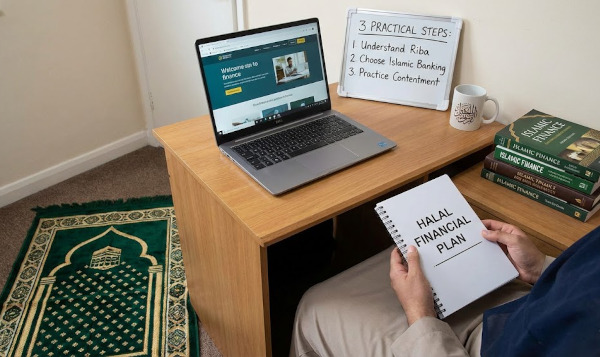
Avoiding Riba in Daily Life: 3 Practical Steps Every Muslim Should Know
Let’s be honest, these days, it feels almost impossible to avoid riba (interest). It’s everywhere, in loans, credit cards, mortgages, even savings accounts. Sometimes we don’t even realize that we’re caught in it until it’s too late.
But here’s the thing: as Muslims, staying away from riba isn’t just a nice idea, it’s something Allah ﷻ clearly warned us against. Avoiding it isn’t always easy, but it’s one of the best ways to protect both our money and our faith.
Allah ﷻ did not just caution us about riba, He declared war against it.
“O you who have believed! Fear Allah and give up what remains of riba, if you are indeed believers. If you do not, then be informed of a war from Allah and His Messenger.” (Quran 2:278–279)
This warning isn’t directed at banks or corporations alone, it’s addressed to every believer. So how do we, as ordinary Muslims, navigate our daily lives in a system that is so deeply entangled with interest?
Here are three practical steps to help us start, or strengthen, our journey toward a riba-free lifestyle.
1. Start by Learning What Riba Actually Is
Before we can avoid something, we have to understand it. Riba in Islam generally refers to any guaranteed interest in loaned money, whether small or large. It includes conventional bank interest, payday loans, and many forms of high-interest credit.
According to the classical scholars, riba is not just forbidden; it is one of the major sins (kabā’ir) in Islam. The Prophet Muhammad ﷺ said:
“Avoid the seven destructive sins.” Among them, he mentioned: “Consuming riba…” (Sahih al-Bukhari & Sahih Muslim)
But it goes beyond just taking interest. The Prophet ﷺ also said:
“The one who consumes riba, the one who pays it, the one who records it, and the two who witness it, all of them are equal (in sin).” (Sahih Muslim)
This hadith reminds us that it’s not just banks or lenders who should worry, if we’re knowingly part of a riba-based transaction, we’re accountable too.
That’s why educating ourselves, even at a basic level, is the first shield. Whether through books, khutbahs, podcasts, or courses on Islamic finance, learning about what riba is and how it hides in modern transactions is a spiritual obligation in today’s world.
2. Re-Evaluate Our Financial Habits and Contracts
Once we know what riba is, the next step is to look at where it exists in our own lives.
Do we keep our savings in a conventional bank account that accrues interest? Are we using credit cards or loans that charge interest on late payments? Do our student loans or mortgages involve riba? Are we investing in bonds or other financial products that promise guaranteed returns?
Let’s be honest: not all of us can instantly switch to a perfect Islamic system. But the Prophet ﷺ taught that intention matters.
“You will never give up something for the sake of Allah Almighty except that Allah will replace it with something better for you.”
(Ahmad, 21996)
This means we start with intentional auditing, reviewing our bank accounts, financial products, and contracts. For many of us, this may mean switching to Islamic banks where available, closing interest-bearing accounts, or even negotiating halal contracts with lenders.
If something can’t be changed right away, for example, a student loan we’ve already taken, then we plan for an exit. We set a goal to pay it off as soon as possible while asking Allah for help and forgiveness.
3. Choose Halal Alternatives and Build New Habits
The beauty of Islam is that it doesn’t just prohibit, it also provides alternatives.
In many parts of the world today, we now have Shariah-compliant financial products like Islamic home financing (Murabaha, Ijarah), halal investments (equity funds, sukuk), and Islamic insurance (Takaful). Even peer-to-peer lending platforms exist that avoid interest altogether.
For everyday expenses, we can use debit cards instead of credit cards or choose prepaid options to avoid late fees and interest. We can also build the habit of saving for big purchases rather than borrowing for them, a simple but powerful way to avoid falling into riba traps.
When we’re stuck between “convenient but haram” and “inconvenient but halal,” choosing the latter becomes a form of worship.
“Indeed, Allah is pure and He only accepts what is pure.” (Muslim, 1015)
And let’s not underestimate the power of dua. Ask Allah to make halal easy for us and haram difficult. Make istighfar often, and surround ourselves with people who also care about living riba-free.
Conclusion
Living without riba in today’s world isn’t easy, but it’s not impossible.
As Muslims, we are called not just to pray and fast, but to honor Allah in our contracts, our earnings, and our financial decisions. Avoiding riba may require sacrifice and discipline, but the reward is peace of mind and barakah in our wealth, and most importantly, the pleasure of Allah ﷻ.
“…And whoever fears Allah — He will make a way out for him and provide for him from where he does not expect.” (65:2–3)
References
- Qur’an 2:278–279 — Warning against riba
- Sahih Muslim — Hadith on those involved in riba transactions
- Sahih Bukhari & Sahih Muslim — Hadith on major sins
- Musnad Ahmad — Hadith on leaving something for the sake of Allah
- Surah Al-Baqarah 2:275–280 — General discussion on riba
- Surah At-Talaq 65:2–3 — Taqwa and provision
- Sahih Muslim —Hadith on Purity of Sustenance